
Best Enterprise CSPM Software for Cloud Security in 2026
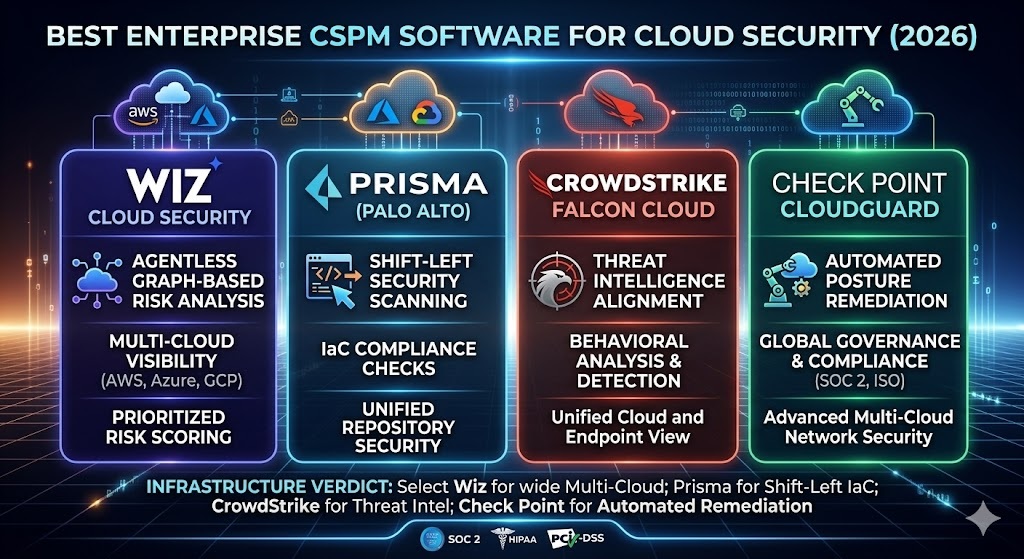

As corporate digital ecosystems migrate heavily into public and multi-cloud frameworks, maintaining visibility over complex security boundaries is an operational challenge. A single misconfigured Amazon S3 bucket, an open security group port, or an unencrypted database instance can expose billions of data rows to the public internet instantly. To discover these infrastructure vulnerabilities automatically, modern IT security teams deploy Enterprise Cloud Security Posture Management (CSPM) Software.
CSPM engines provide continuous visibility across multi-cloud environments, analyzing active storage buckets, identity controls, and network bridges against strict compliance baselines.
This technical engineering review compares the premier enterprise CSPM tools, analyzing multi-cloud coverage speeds, automated remediation triggers, and continuous compliance mapping frameworks.
The Architecture of Cloud Posture Management
Why Manual Cloud Auditing Fails
In a live DevOps environment, cloud engineering teams spin up and tear down thousands of virtual microservices, database clusters, and API gateways every day. Manually auditing these fast-moving changes via spreadsheets is impossible. CSPM platforms solve this by connecting directly to your cloud infrastructure via read-only APIs, scanning your entire cloud matrix every few minutes to flag security risks in real time.
Leading Enterprise CSPM Frameworks
| CSPM Software Vendor | Multi-Cloud Integration | Core Target Environment | Outstanding Infrastructure Strength |
| **Wiz Cloud Security** | AWS, Azure, GCP, OCI | Massive multi-cloud footprints | Agentless graph-based risk prioritization |
| **Prisma Cloud (Palo Alto)** | Hybrid / Multi-Cloud | Global enterprise architectures | Deep shift-left code security scanning |
| **CrowdStrike Falcon Cloud** | AWS, Azure, Google Cloud | Distributed endpoint environments | Native threat intelligence alignment |
| **Check Point CloudGuard** | Public & Private Cloud | High-governance data networks | Advanced automated posture remediation |
Critical Operational Performance Features
1. Agentless Graph-Based Risk Analysis
Traditional security software required installing a heavy tracking app (agent) inside every single virtual machine. Modern CSPM platforms utilize agentless API scanning. By drawing a visual “risk graph,” the engine maps how cloud assets are connected, quickly identifying dangerous combinations—such as an unpatched virtual machine that holds private client data and is directly exposed to the public internet.
2. Automated Posture Remediation Loops
Discovering a cloud vulnerability is only half the battle; fixing it before hackers find it is critical. Advanced CSPM platforms feature automated remediation playbooks. For example, if a developer mistakenly opens a database port to the public web, the CSPM engine instantly catches the change, alerts the security team, and automatically overwrites the firewall policy to close the port in seconds.
3. Continuous Compliance Mapping
Before deploying customer applications, enterprise networks must satisfy strict regulatory compliance baselines (such as SOC 2, ISO 27001, or PCI-DSS). CSPM software continuously tests cloud setups against these international frameworks, generating audit-ready report sheets automatically and identifying non-compliant systems instantly.
The Infrastructure Verdict: Selecting Your Cloud Shield
* **Deploy Wiz if:** Your architecture runs a heavy mix of multiple cloud vendors and you require an agentless setup that instantly flags the most critical risks.
* **Deploy Prisma Cloud if:** Your engineering team utilizes infrastructure-as-code (IaC) deployment pipelines and wants to catch security flaws before the cloud infrastructure is even built.
* **Deploy CrowdStrike Falcon Cloud if:** Your organization already utilizes CrowdStrike for endpoint protection and wants a single, unified security dashboard.
To securely manage the automated defense playbooks that interact with your cloud network nodes, read our technical breakdown of the [Best Enterprise SOAR Platforms for Security Automation] to fully optimize your infrastructure governance!